Was Life Better Before Social Media?
We are more connected than ever, and lonelier than ever. A thought on what the feed took from us — and what's still worth reclaiming.
This last year when walking through Washington Square Park on a late-autumn afternoon, there was a familiar hum in the air. The musicians play, filling the space with the sound of jazz and folk. Students drift in and out of the park, textbooks in hand, while tourists snap photos of the iconic arch. To this day, it is my favorite place in the city. But if you look closer, you'd have seen something that would have been almost unthinkable just twenty years ago: heads bowed, not in conversation, but in concentration — on screens. Couples sit side by side on benches, not talking but scrolling through their phones. Friends who once might have been deep in conversation are now preoccupied by the flicker of notifications and the endless scrolling that comes with platforms like TikTok, Instagram, and YouTube. Once a hub of spontaneous connection and interaction, the park now feels quieter, not in sound, but in spirit. People are present physically, but their minds seem somewhere else, somewhere digital.
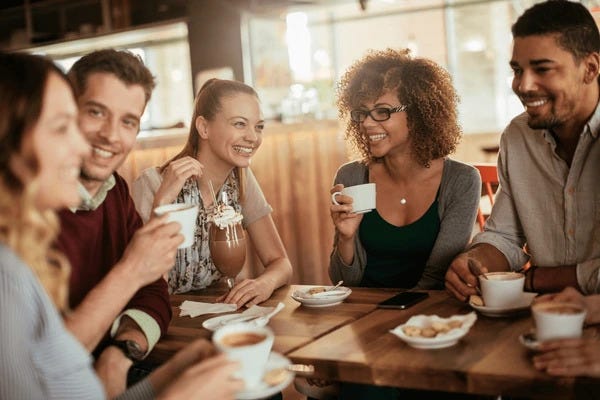
Step inside Devoción on Lexington Ave, where the warm glow of light filters through the large panel windows, casting long shadows across the tables. In the 90s and even early 2000s, a place like this would have been filled with lively conversation. Strangers might have struck up a chat while waiting for their lattes, or friends would have laughed over the day's events, soaking in the ambiance. But now, you're more likely to see the gentle glow of phones reflecting off their cups of coffee. People sit together but apart, immersed in the curated lives that flicker across their screens rather than in the rich, textured reality of the moment.
There was a time when being in the park or a café meant engaging with the world around you, where eye contact, laughter, and conversation were the currency of connection. In the late 90s and early 2000s, people were immersed in the present with the texture of life unfolding in real time. The person across from you wasn't a distraction from your phone; they were the focal point. Strangers exchanged ideas, neighbors discussed the latest neighborhood news, and the moment, in all of its imperfections, was shared together.
But as the 2000s progressed, a shift began. What started as a way to stay connected, to keep in touch with friends and family and share moments from afar, slowly began redefining how we experience the world. Social media crept in, not with a bang but with a whisper, gradually pulling our attention from the tangible to the digital. By the time we noticed the change, the world was already different. Conversations became fragmented, interrupted by the constant ping of notifications. Our gaze shifted from the person across the table to the phone in our hand, where curated images and updates from faraway friends pulled us away from the richness of the present. Now, we find ourselves in a strange paradox where people today are more connected than ever, yet more alone. With all its promises of community and connection, social media has woven itself into the fabric of our daily lives. Still, in doing so, it has fundamentally altered how we interact with the world around us. Where once we were fully engaged with the people and places we encountered, now our attention is divided. The vibrant conversations that used to fill those coffee shops and parks are muted, replaced by the quiet scrolling of digital feeds. The question we must now ask ourselves is this: has life truly improved in this hyper-connected world, or have we lost something more meaningful along the way?
One of the most significant changes brought about by social media is how it has redefined our relationships, particularly for younger generations. For teenagers, the effects are especially stark. In the early days of social media, platforms like MySpace, Facebook, and Instagram offered a novel way to stay connected with friends, share moments, and belong to a broader digital community. But with time, what was once an exciting new space has become a battleground for mental health. Studies show that social media use is linked to increased levels of anxiety, depression, and loneliness, particularly among teenagers. A 2021 report from The Journal of Adolescence found that adolescents who spend more than three hours a day on social media are 60% more likely to report symptoms of depression. What was once playground teasing has evolved into 24/7 cyberbullying, where there's no escape from the torment. A separate study by the National Institutes of Health found that nearly 25% of teens who spend the most time on social media report feeling socially isolated, which is a sharp contrast to those who spend more time in face-to-face interactions. The pressure is constant, the audience vast, and the wounds from cruel comments are far-reaching.
But it's not just bullying. There's a more subtle but equally damaging effect: the relentless comparison. Not long ago, we measured ourselves against those in our immediate circle, but social media has opened the floodgates to a world of endless, curated perfection. Every scroll introduces us to people living extraordinary lives — exotic vacations, luxurious homes, and infinite success. A 2022 study from University College London found that nearly 40% of social media users report feelings of inadequacy after viewing content from influencers or celebrities, often comparing their own lives unfavorably. This sense of comparison is heightened by the polished, curated nature of social media content, which, according to Psychology Today, has been linked to increased rates of depression and anxiety, particularly in young adults. The rise of FOMO, or fear of missing out, has become a defining feature of modern life. We're constantly reminded of all the things we're not doing, all the places we're not seeing, and all the successes we're not achieving. And for many, especially the young, it can feel overwhelming.
Yet, even with all the negatives, it's impossible to ignore how social media has brought us closer. Long-lost friends have been reconnected, families separated by distance can share their lives with a simple click, and social movements that might never have gained traction have found a platform. In moments of global crisis, like the COVID-19 pandemic, social media became a lifeline, a way to stay connected, to check in on loved ones, and to share critical information.
But again, here's the paradox: in a world where we are more connected than ever before, why do so many people feel alone? In 2023, the U.S. Surgeon General declared loneliness a public health epidemic, with reports showing that nearly 50% of U.S. adults say they struggle with loneliness. This figure has risen steadily since the rise of social media. A Harvard Study of Adult Development revealed that people with over 1,000 social media connections still report lower levels of happiness and belonging than those with fewer but deeper in-person friendships. This loneliness crisis has deepened despite the fact that we can instantly connect with anyone across the globe. The problem isn't just that social media has created superficial relationships; it's that it has changed the very nature of how we connect. Instead of building deep, meaningful relationships, we've traded real conversations for likes, comments, and follows. The kind of connection that nourishes the human soul. The face-to-face, spontaneous interactions have been replaced by an algorithm that feeds us content, not community.
The erosion of this community is not just a byproduct of social media; it's also a reflection of how we've begun to wall ourselves off into digital echo chambers. One of the greatest promises of the internet and social media was the idea of a global village. In this place, diverse ideas could be exchanged, and you could encounter perspectives vastly different from your own. However, somewhere along the way, that promise was lost. Algorithms, designed to keep us engaged, began feeding us more of what we liked, more of what we agreed with, and more of what confirmed our beliefs. A 2019 study by Pew Research Center found that 64% of U.S. adults believe social media has a mostly negative impact on the way people interact, with 55% of users stating that platforms like Facebook and Twitter contribute to political and ideological polarization. Moreover, research published by Nature Human Behaviour suggests that algorithms designed to prioritize engagement often reinforce existing beliefs, reducing the likelihood of exposure to diverse perspectives. Over time, our feeds became tailored to our preferences, and what was once a diverse marketplace of ideas became a comfortable bubble of sameness. In these echo chambers, we found comfort, but at a cost. We avoided the discomfort of being challenged. Civil discourse, once a hallmark of healthy communities, has been replaced by comment-section battles where nuance is often lost and opposing viewpoints are met with hostility. Where once a disagreement might have been an opportunity for a respectful debate over coffee, it now becomes an opportunity to block or unfollow. Our digital interactions allow us to filter out the uncomfortable, the differing, and the dissenting. And with that filtering, we've lost the opportunity to grow through engagement with perspectives that don't mirror our own.
Beyond this, perhaps what's most concerning is that this retreat into digital spaces has significantly impacted our ability to connect in meaningful, human ways. A study by the Pew Research Center found that while social media users often feel "connected" to a larger group, they are less likely to experience close, personal connections. The depth of those relationships has been replaced by breadth. We may have thousands of Facebook friends or Instagram followers, but ask yourself this: how many of them do we really know? How many would we turn to in a moment of crisis? The very tools that were designed to bring us closer together have, in many ways, pushed us further apart.
This is where the question of whether life was better before social media becomes so complex. On the surface, the answer might seem obvious. Social media has allowed us to reconnect with old friends, share our lives with family members across the globe, and stay informed in ways that were unimaginable just two decades ago. It has given a voice to the voiceless, empowered social movements, and democratized access to information. These are no small feats. In many ways, social media has been a force for good.
But beneath that surface lies a deeper, more troubling truth. In our pursuit of connection, we've traded quality for quantity. We've become more connected, yet we've never felt more alone. It is incredible ironic. An entire generation, raised with the promise of endless connection, now faces an epidemic of loneliness. The same platforms that allow us to reach anyone, anywhere, at any time, are the ones that make us feel as though we're not truly seen by anyone at all, and it's not just the digital loneliness that stings. The impact on our sense of community is also intense. Without third spaces, without the parks, cafés, and libraries, we've lost the physical environments where real connection once flourished. These places, as I've discussed before, were where community happened. They didn't demand anything of us other than our presence; in return, they gave us belonging. But as we retreat further into our screens, these spaces are fading, and the human connections that once grounded us are becoming harder to find.
The real challenge now is not just recognizing what we've lost but figuring out how to reclaim it in a way that fits the modern world. It's easy to romanticize the past, to long for a time before smartphones dominated every interaction, but the truth is, social media isn't going anywhere. It has become too deeply integrated into our lives and offers real benefits. But just because social media is here to stay doesn't mean we can't reshape our relationship with it. The question isn't whether life was better before social media but whether we can make life better now, even with it. What we need isn't necessarily a rejection of social media but a rebalancing of it. We need a conscious effort to reinvest in the spaces and relationships that ground us. In a world where digital connection is always available, we must make room for deeper, more meaningful interactions that can only happen offline. Imagine a future where those third places return to their former roles as community anchors, not just places to grab a quick coffee and leave, but places where people go to linger, talk, and simply be present with each other. This isn't about nostalgia for a time before the internet; it's about acknowledging the human need for spaces where connection happens organically, without the mediation of a screen.
Social media will always be part of our lives, but we must remember that it can't be the entirety of our lives. Scott Galloway, whose insights on loneliness and masculinity I've long admired, speaks often about the need for physical spaces where people can engage with one another face-to-face. As Galloway says, we've been too quick to trade connection for convenience. But the good news is, we can reverse course. We can choose to seek out the real over the virtual, the deep over the shallow. It starts by stepping away from the screen and stepping back into the world around us, reclaiming the third space that has always been the foundation of human connection.
The future isn't about turning off social media; it's about turning it into just one tool among many, rather than the only one we rely on. It's about learning to use social media for what it does best, for staying informed, sharing moments, and reconnecting with distant friends, while remembering that the most important relationships are still built in the real world through shared experiences, conversation, and presence. We need to reintroduce depth into our interactions and rebuild the communities that give us a sense of belonging. The answer to whether life was better before social media is less about looking back and more about moving forward. The real question is: can we create a world where social media enhances our connections without replacing them? Can we balance the convenience of digital interaction with the richness of real-world relationships? If we can learn to integrate the best of both worlds, then perhaps we can reclaim what's been lost, and in doing so, create something even better.
It's time to put the phone down, walk into the café, and rediscover what it means to truly connect.